Somatic
가족 생애 주기 시니어
인생 코칭 목회를 전문으로 하는
온라인·오프라인 교회의 맥락적 여정 1.
Grace & Home Church
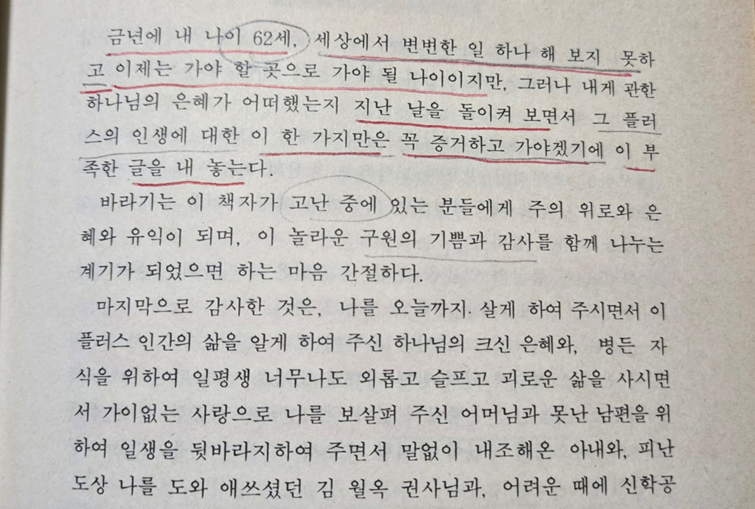

위의 글은 내가 열아홉 살이던 시절,
신학교에서 강의하시던 최순직 목사님의 자서전
「플러스 인간의 삶」을 여는 첫 문장이다.
목사님은 예순두 살을 맞으며
“이제는 가야 할 곳을 향해 가야 할 나이”라고
담담히 마음을 고백하고 계셨다.
나는 지금 예순다섯 살이다.
그때의 최 목사님보다 훨씬 더 많은 세월을 지나왔다.
나 또한 죽음 이후에 가야 할 곳을 향해
조용히 걸어가고 있다.
이 글을 쓰는 일도
남은 삶을 잘 정리하고
나름대로 완성해 보려는 마음에서 시작되었다.
사실 이 글은
목사님이 예순두 살에 쓰신 글이 아니다.
예순 살 무렵에 쓰신 글이다.
그리고 그 내용은
목사님이 쉰여덟 살에 방배동 신학교에 오셔서
특강을 하셨던 때의 마음을
쉰아홉 살의 시점에서 기록한 것이다.

그때의 모습을 나는 지금도 기억한다.
부정맥이 심해
언제, 어떻게 될지 모른다며
“오늘이 마지막 강의가 될지도 모른다”고
눈물로 강의하시던 모습이었다.
베개 옆에는 작은 녹음기가 있었다.
혹시라도 마지막이 될까 봐
유언을 남길 준비를 하셨다고 한다.
숨이 차서 누워 있지도 못하고
잠도 오지 않는 밤,
생각나는 대로 마지막 말을 녹음해 두고
죽음을 기다리듯
침상에 조용히 누워 계셨다는 그 이야기.
이제는 그 마음이
내게도 깊이 와닿는다.
인생의 마지막 말이란 무엇일까.
유언이란 어떤 것일까.
녹음기에 남기는 마지막 메시지는 무엇일까.
오늘을 살아가는 시니어들과
그들의 자녀들에게
나는 이 질문을
조용히 던져보고 싶다.
최 목사님의 제자는
백석대학교 설립자 장종현 목사였다.
그 시절 강의가 이루어졌던 학교는
설립 초기의 방배동 신학교였다.
https://www.bu.ac.kr/web/3613/subview.do 신학은 학문이 아니다 (백석대 설립자 신학관)
방배 전철역 백석 신학교
그분이 내게 주신 신학의 길잡이는
6일 신학, 그리고 초교파 6일 크리스천 네트워크 사상이었다.
또 하나 기억나는 것은
목사님이 학장으로 계실 때
칭찬과 격려로 가득했던 과목,
장종현 목사와 동향 선배인
허광재 목사에게서 배운
기독교 여성신학이었다.(행복하고 싶으면 사랑하십시요,행복 사랑)

나는 이런 신학적 배경을 품고
서른 살까지 한국에서 살았다.
1988년에 결혼하고,
1990년 11월,
아들이 생후 아홉 달 되었을 때
미국으로 이민을 오게 되었다.
최 목사님의 자서전 전체의 맥락은
몸의 투병과 신학의 여정,
즉 목회자의 몸과
그리스도의 몸인 교회에 대한 이야기였다.
나에게 “기독교 여성신학”은
여성의 몸,
출산과 양육의 몸에서 출발했다.
결혼을 전제로 한 가정관,
그리고 그리스도의 신랑·신부 모델로서의 교회관이
자연스럽게 이어졌다.
그래서 나는
예수님의 공생애를 요약한
마태복음 4장 23절과 9장 35절,
곧 천국 복음 전파와 치유 사역을
한 단어로 정리했다.
그 단어가 바로 Somatic 치유 사역이다.
이 사역은
새크라멘토에서
새크라멘토 안식일교회 마르페(Healing) 치유봉사선교회와
자연스럽게 연결되었다.
Somatic Family Life-Cycle Senior Life Coaching Ministry
The Contextual Journey of an Online–Offline Church
Grace & Home Church
The passage above is the opening section of “The Life of a Plus Human”, the autobiography of Rev. Choi Soon‑jik, who lectured at my seminary when I was nineteen.
At age sixty‑two, he wrote about his conviction that he had reached the stage of life where one must begin preparing for the place one is ultimately going.
I am now sixty‑five—well beyond the age he was when he wrote those words.
I, too, am walking toward the place one goes after death.
Even the act of writing this now comes from my desire to organize my remaining years and bring them, in some way, to completion.
This passage was not written when he was sixty‑two, but when he was sixty.
He had visited Bangbae‑dong Seminary for a special lecture at age fifty‑eight, and the autobiography reflects his thoughts around age fifty‑nine.
I remember that time clearly.
Because of dangerous arrhythmia, he said he did not know when or how his life might end.
He told us that the lecture he was giving that day might be his last, and he taught with tears.
He kept a recorder next to his pillow, preparing to leave a final message “just in case.”
He recorded his last thoughts in a breathless voice, unable to lie down or sleep, waiting for death as he lay motionless on his bed.
Now, at this age, I understand what he meant.
What are the final words of a human life?
What is a “last will”?
What does one record when leaving a message for those who remain?
These are simple but profound questions I want to ask today’s seniors and their children as we reflect on Life.
Rev. Choi’s student was Rev. Jang Jong‑hyun, the founder of Baekseok University, and the school where Rev. Choi lectured was the early Bangbae‑dong campus of Baekseok Seminary.
(Reference: Baekseok University – “Theology Is Not an Academic Discipline,” the founder’s theological perspective)
Bangbae Subway Station – Baekseok Seminary
The guiding theology he gave me was the Six‑Day Theology and the Interdenominational Six‑Day Christian Network.
Another influence was the course “Christian Feminist Theology,” which he taught as dean, introduced to him by Rev. Jang Jong‑hyun and Rev. Heo Gwang‑jae, both senior pastors from his hometown.
Holding these convictions, I lived in Korea until age thirty.
I married in 1988, and in November 1990, when my son was nine months old, I immigrated to the United States.
The overarching theme of his autobiography is the journey of his suffering body and his theological path—the body of the pastor and the Body of Christ, the Church.
For me, “Christian feminist theology” naturally connected to the woman’s body of childbirth and nurturing, the family grounded in marriage, and the Church as the Bride of Christ.
This shaped my understanding of Jesus’ public ministry summarized in Matthew 4:23 and 9:35—proclaiming the gospel of the Kingdom while healing every disease and every weakness.
I came to describe my own ministry with one word: Somatic Healing Ministry.
In Sacramento, this eventually connected with the Marpe (Healing) Ministry of the Sacramento Seventh‑day Adventist Church.
'여정' 카테고리의 다른 글
| 온라인 오프라인 교회의 맥락적 여정 3. (0) | 2026.03.24 |
|---|---|
| 온라인·오프라인 교회의 맥락적 여정 2. (0) | 2026.03.24 |
| 새벽시간에 한국 강물 코치님 NLP 코칭 학습시간 후 (0) | 2026.03.20 |
| 새크라멘토 한인회 이사회 나의 참석기 My Reflections on Attending the Sacramento Korean Association Board Meeting (1) | 2026.03.14 |
| 비폭력대화와 사랑의 대화 (0) | 2026.03.13 |